

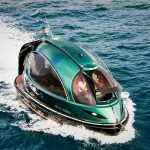




If you’ve ever spotted a small, sleek pod skimming across a marina in Monaco, Dubai, or Miami that resembles half yacht, half spaceship, you may have seen a Jet Capsule in the wild. These compact watercraft, with their bubble-like shells and minimalist styling, look like something out of a science fiction film. And yet, they’re very real. They’ve been used as luxury mini-yachts, high-end water taxis, and promotional vessels for the ultra-curious. For many, the Jet Capsule is the first and only glimpse into the world of its creator, Pierpaolo Lazzarini, a designer whose ideas often seem to float just beyond the horizon of what’s currently possible.
A Designer Who Refuses to Stay on Land

Lazzarini was born in Rome in 1982 and trained in car design at Milan’s Domus Academy. But while his education followed the conventions of industrial and automotive design, his career has been anything but conventional. Since founding Lazzarini Design Studio in 2010, he has produced a prolific body of work that defies architectural categories. His portfolio features floating pyramids, solar-powered saucers, carbon-fiber watercraft, and airborne yachts. Some are homes. Others are hotels. They all resemble science fiction, and something more.
What all these creations share is a vision of life liberated from land, designed to meet the challenges of a changing planet.
Lazzarini rarely works within the bounds of zoning laws, city plans, or conventional client briefs. Instead, he designs speculative, buildable solutions that explore how we might live in the near future, particularly on water. His concepts appeal to a world rethinking urbanism, mobility, energy, and environmental resilience. They don’t just solve problems; they offer alternative realities.
The Jet Capsule: From Concept to Commercial Success
Of all his designs, the only one that has come to fruition so far is the Jet Capsule. Launched in 2013 at the Monaco Yacht Show, it was Lazzarini’s answer to a deceptively simple question: why do all boats look the same? His response was a sleek, futuristic pod built like a “smart car for the sea.” Enclosed, customizable, and quick, the Jet Capsule could serve as a private yacht, a commuter boat, a water taxi, or even a military vessel.

Unlike many of his larger projects, the Jet Capsule was practical in both scale and purpose. It could be manufactured in his home country, Italy, customized for each client, and sold at a relatively affordable price. Over the past decade, it has been delivered to clients across the United States, Spain, China, and the Middle East. Its success gave Lazzarini global visibility and helped fund the development of even more ambitious concepts.
The original Jet Capsule
Built in Italy through a partnership with S3, Jet Capsules are typically 7.5 to 8.15 meters long and around 3.4 meters wide, weighing between 2,500 and 3,000 kg. The structure is made primarily from carbon fiber, which helps reduce weight while increasing durability. Seating ranges from 6 to 12 passengers plus a pilot, depending on configuration. Early models used 300–500 horsepower Hamilton Jet Drive engines with top speeds of 25 to 38 knots. Later editions have pushed further.
The Super Sport

In 2024, Lazzarini Design Studio released two new variants: the Jet Capsule Super Sport and Hyper-Sport. The Super Sport uses a vacuum-infused carbon fiber shell, dropping weight by about 500 kg compared to earlier builds. It’s powered by a 640–850 hp V8 engine and features a full-electric docking system for quiet, low-speed maneuvering.
The Hyper-Sport
The Hyper-Sport goes further, with a top speed of up to 45 knots, photochromic windows, night vision, radar, a 24,000 BTU air conditioner, and modular interior options like a kitchen, convertible beds, and bathroom. It seats 10 passengers plus the pilot and offers a 220-mile range. Pricing starts around $550,000 with a build time between 8 to 18 months.
Across the product line, propulsion is handled by Hamilton Jet Drives or Yanmar/Ilmor marine engines, with newer models integrating electric assist for docking. Hybrid and full-electric versions are planned. Onboard tech includes GPS, radar, sonar, autopilot, LED lighting (including underwater), and touchscreen interfaces. Night vision and surveillance cameras are available in higher-end models. Interiors are fully customizable with options like leather upholstery, convertible lounges, dining tables, sun decks, and marine-grade bathrooms.

Jet Capsules have been sold and delivered to buyers in China, Canada, Spain, the U.S., and the Middle East. In Florida, they’ve even been rented for parties. Prices have ranged from $150,000 to over half a million dollars, depending on the version and features.
Lazzarini’s goal was to offer something modular, stylish, and efficient, a vehicle that could serve as a commuter, luxury tender, military vessel, or private water retreat. From high-end resort taxis to mobile guest suites, the Jet Capsule has been adapted for a wide range of uses. And in a world moving toward sustainability, compact luxury, and personalized design, this “smart car for the sea” has carved out a unique niche—equal parts marine innovation and design statement.
An even closer look at the Jet Capsule series

Jet Capsule Super Sport (2024)
- 8 m carbon‑fiber shell, built with vacuum‑infusion molding to be ~500 kg lighter than earlier versions newatlas.com+9thearsenale.com+9wired.com+9.
- Equipped with a 640–850 hp engine (V8), top speed 38 knots, full-electric docking system for silent low-speed maneuvering
- Accommodates up to 12 guests; interior layout fully customizable (dining area, bathroom, sunbed-access ladder) lazzarinidesignstudio.com+5thearsenale.com+5grumpyfoot.com+5.
Jet Capsule Hyper‑Sport (2024)

Price reportedly starts at USD ~550k with 8–18 month build time techeblog.com.
- Evolved from Super Sport: seats 10 + pilot, 640 hp supercharged V8, 38–45 knots top speed designboyo.com+9designboom.com+9thearsenale.com+9.
- Photochromic windows, radar & night vision, 24,000 BTU A/C, customizable kitchen, bathroom, transformable beds, sundeck designboom.com+2designboom.com+2techeblog.com+2.
- Dimensions ~8.15 × 3.44 m, light structure (~70 % carbon fiber), fuel for about 220-mile range thearsenale.com+3designboom.com+3designboom.com+3.
Jet Capsule (since ~2013)
- Compact luxury pod‑boat (~7.5–8 m long, seating for 8–12), with customizable interior incl. kitchen, bathroom, convertible beds, like a “camper‑van for the sea” designboom.com+5jetcapsule.it+5thearsenale.com+5wired.com.
- Early models: 300–500 hp Hamilton jet engines, 25–38 knots top speed, teak deck and rooftop lounging platform.

Jet Capsule Mini‑Yacht Pod (since ~2017)
- Launched & Delivered: The prototype debuted around 2013 at the Monaco Yacht Show, and production models have been delivered internationally, including orders fulfilled in China, Spain, Canada, and Florida rentals as early as 2017 jetcapsule.it+15m.economictimes.com+15nautechnews.it+15.
Construction & Specs: Built in Italy (via a partnership with S3), it’s a ~7.5 m long carbon-fiber “bubble yacht” offering seating for up to nine people, with options for kitchen, bathroom, sun deck, and speeds up to ~35 knots powered by 300–500 hp engines autoevolution.com.
Market Presence: Jet Capsules have been hired out (e.g., for parties in Florida) and sold worldwide for prices ranging from ~$150k to ~$250k autoevolution.com+10watercraftjournal.com+10m.economictimes.com+10.
Other Designs, Projects
Despite the creativity and technical realism of Lazzarini’s many other projects, such as U.F.O., U.F.O. 2.0, Wayaland, PearlSuites, Colossea, and Pangeos none have yet been built since this article was written. This is not because they are unfeasible. On the contrary, many of them are carefully engineered and could be constructed using today’s materials and marine technology. The primary barriers are scale, cost, and regulation.

Take Pangeos, for example. It’s a massive turtle-shaped floating city measuring over 550 meters (1804.5 feet) in length and designed to house 60,000 people. While breathtaking in design and entirely plausible on paper, it would require a dry dock larger than any currently in operation, and an estimated budget of $8 billion in early-21st-century currency. Such a project can’t be built without government involvement, sovereign wealth, and long-term international partnerships. Wayaland, a modular city of floating pyramids, faces similar logistical and financial hurdles. Though smaller in scope, it still requires infrastructure, maritime policy reform, and deep investment to move beyond renderings.
A breakdown of the obstacles
A private yacht can be purchased and delivered. A floating city needs zoning, public policy, and infrastructure planning.
Second, cost remains a major roadblock. While a Jet Capsule may cost under a million dollars, most of Lazzarini’s other projects begin in the tens or hundreds of millions, with Pangeos reaching into the billions. That level of financing requires institutional support or visionary investors with substantial financial backing.

visionary blueprint — a floating city that awaits the kind of massive funding and legal navigation that only the boldest backers dare tackle.
Third, there’s the issue of regulation. Many of his designs don’t fit neatly into maritime or terrestrial legal systems. Floating residences, moving resorts, and mobile cities raise questions about jurisdiction, insurance, and ownership rights. Without precedent, regulators and investors remain hesitant.
Even smaller-scale concepts like PearlSuite, a floating hotel room powered by solar energy, or U.F.O. 2.0, a saucer-shaped off-grid sea home, remain stuck in the idea stage. While they are more approachable in terms of cost, the market remains cautious. Resort developers and early adopters admire the designs but hesitate to take the first leap into unknown waters, both literally and legally.
Finally, Lazzarini’s studio, while brilliant, remains small and independent. It is a creative engine, not a multinational corporation. The studio produces ideas, renders, and buildable specs, but relies on outside developers or governments to fund and construct them.
Concept Overboard: More About The Wild Nautical Visions Lazzarini Has Yet to Launch
U.F.O. & U.F.O. 2.0 – Floating Disc Homes of the Future
The U.F.O. series represents Lazzarini’s ongoing obsession with floating architecture that challenges the norms of both design and habitation. Whether these structures ever become reality or not, they continue to capture the imagination of anyone fascinated by the future of off-grid, sea-bound living.

In 2017, Lazzarini followed up with U.F.O. 2.0, a more ambitious, three-level evolution of the original concept. This version pushed the boundaries further, both in livability and complexity. By 2020, a smaller, two-level version was introduced, streamlining the idea without losing its core appeal. Still, like its predecessor, U.F.O. 2.0 remains a concept—bold on paper, but not yet realized in the real world.
This futuristic structure is more than just a design gimmick. It integrates real-world sustainability systems, including water desalination, battery storage, and ballast tanks for controlled submersion. While it’s not built for speed—it moves at a modest pace of about 3.5 knots—it can anchor in place using a four-point mooring system, making it ideal for calm waters. Despite the buzz it generated during its crowdfunding campaign, the original U.F.O. has yet to be constructed.

Pierpaolo Lazzarini’s U.F.O. series—short for Unidentified Floating Object—takes the idea of off-grid living to a whole new level, quite literally. The original U.F.O., also called U.F.O. 1.2, is a disc-shaped floating habitat spanning 12.5 meters in diameter. Designed with two main living levels, it features an upper sun deck and entry platform above the waterline, while the bedroom and bathroom are fully submerged beneath the surface—roughly 2.3 meters underwater.
PearlSuite: Floating Luxury, Reinvented for the Eco-Minded Traveler
The PearlSuite is a solar-powered, single-level floating pod designed by Pierpaolo Lazzarini as a response to the rising demand for off-grid, sustainable travel experiences. Measuring 7 meters in diameter and offering roughly 22 square meters of interior space, it’s a self-contained suite that brings boutique comfort directly onto the water—no coastline construction required.
Customizable and Private

Its smooth, domed structure features a retractable roof made from photochromic materials that automatically adjust to sunlight, offering open-air ambiance or privacy as needed. When fully extended, the dome reaches a height of 2.5 meters, creating a spacious, light-filled interior environment.
The layout is fully customizable, typically including a sleeping area with panoramic views, a compact kitchenette, and a modern marine bathroom. Additional options include a rooftop sun deck, smart lighting and blinds, and fold-out elements for lounging or dining. The design comfortably accommodates 2 to 4 guests.
The PearlSuite is powered entirely by solar energy and can be equipped with an electric propulsion system (~25 horsepower), allowing it to cruise slowly at around 5 knots. It’s not a yacht, but it can reposition itself when needed. Optional tech upgrades include gyroscope-based stabilizers for smoother floating and the ability to cluster multiple units into a floating resort network or retreat.

Constructed from lightweight composites like carbon fiber and fiberglass, the PearlSuite is engineered for low impact and high mobility. It’s suited for use in eco-resorts, private islands, marinas, Airbnb-style aquatic rentals, or cruise excursions.
Although still in its conceptual stage, the PearlSuite is considered production-ready and available for commissioning upon client interest. For developers, it’s a scalable solution. For travelers, it’s a secluded escape with all the perks of a five-star room, just without the land beneath it.
Wayaland: The Pyramid That Floats
Wayaland is Pierpaolo Lazzarini’s utopian vision of a floating micro-nation, a modular marine city inspired by ancient architecture and futuristic thinking. Its primary structure is a stepped, pyramid-like form built atop a wide floating base. The design is scalable and stackable, made up of multiple interlocking modules that could be used for living, hospitality, business, or even governance.

The core unit of Wayaland is the Waya, a self-sustaining floating building. Each Waya is constructed using lightweight, marine-grade materials like fiberglass and carbon fiber, and can be adapted for various uses: hotel rooms, offices, private villas, or entertainment venues. The tallest version reaches up to 30 meters high, with multiple floors and open terraces offering panoramic views.
Wayaland is fully off-grid by design. Solar panels, wind turbines, and water filtration systems are integrated directly into the structures, allowing them to function independently. Some units include propulsion systems for slow movement or relocation, while others are meant to remain stationary and moored in coastal waters.

A proposed central floating city could be formed by clustering multiple Wayas into a grid-like floating metropolis. Lazzarini even envisioned floating borders, mobile harbors, and international waters as future “real estate” for Wayaland development. A crowdfunding campaign once attempted to raise funds for a prototype, offering “citizenship” and design input for early supporters.
Though not yet realized, Wayaland pushes the limits of floating architecture and introduces a provocative question: what if we didn’t just build on land or sea, but claimed both, freely and modularly?
Pangeos: The Terayacht Designed to Be a Moving City

Pangeos is Lazzarini’s most ambitious marine concept yet—a floating, turtle-shaped megastructure designed to house an entire city at sea. With a proposed length of 550 meters and a wingspan of 610 meters, it would dwarf every vessel ever built, earning it the title of a terayacht.
The name is a nod to Pangaea, the ancient supercontinent, reinforcing the idea that this is not just a ship, but a floating landmass. Inside its curved shell-like design are zones for residential housing, commercial centers, hotels, parks, shopping districts, and even ports for smaller boats and aircraft. The interior layout mimics that of a small city, with dedicated zones for hospitality, transit, entertainment, and administration.

Pangeos is designed to be completely self-sufficient, powered by a combination of solar panels, wave energy converters, and electric propulsion systems. It’s intended to cruise indefinitely across oceans at a slow, steady pace, with enough onboard infrastructure to support thousands of people.
While Pangeos remains a conceptual project, renderings and detailed engineering plans have been released, and discussions have taken place regarding building a massive shipyard in Saudi Arabia to bring the project to life. The estimated construction cost is in the multibillion-dollar range, and the build timeline, if greenlit, would stretch into decades.
Still, as a design exercise, Pangeos offers a radical rethinking of mobility, real estate, and human habitation. It’s not just a yacht or a city—it’s both, envisioned on a scale that rewrites what’s possible on the water.
A Visionary Still Waiting for the Right Partner
Despite these challenges, Lazzarini’s influence continues to grow. His concepts have gone viral on social media, circulated through major design publications, and inspired other designers and developers to rethink what is possible on the sea. His designs are not wild fantasies. They are realistic proposals waiting for the right combination of funding, vision, and risk tolerance.
What sets Lazzarini apart is that he doesn’t try to fit into the design world’s existing rules. He operates at the edges, proposing what comes next, not what fits into now. In doing so, he’s become one of the most important figures in speculative architecture and marine design. His work speaks not just to architects and investors, but to a larger cultural imagination: the idea that we don’t have to stay rooted on land or locked into old systems. We can float. We can move. We can change.
If someone, somewhere, whether a forward-looking country, a climate resilience fund, or a visionary billionaire decides to act, Lazzarini’s floating cities, homes, and retreats could become more than designs. They could become history’s first steps into a truly mobile civilization.
Your thoughts?
Do you own a Jet Capsule or ever rode in one? What was it like? Do you want one? Why or why not. Also, what do you think of Lazzarini’s other projects? If money and laws were no obstacles, which one would you like to see come to fruition, and why? Post your comments below!
Also check out more interesting people here and other interesting boats and other things that float here if you’re looking for more stuff to read!